Generating and measuring impact on gender equality and social inclusion
Creating and measuring impact for gender equality in food systems is paradoxically about much more than data—it requires tangible change beyond participation to decision-making power. Conference panelists discussed this recently, and reflected on the enabling mechanisms of this kind of change.
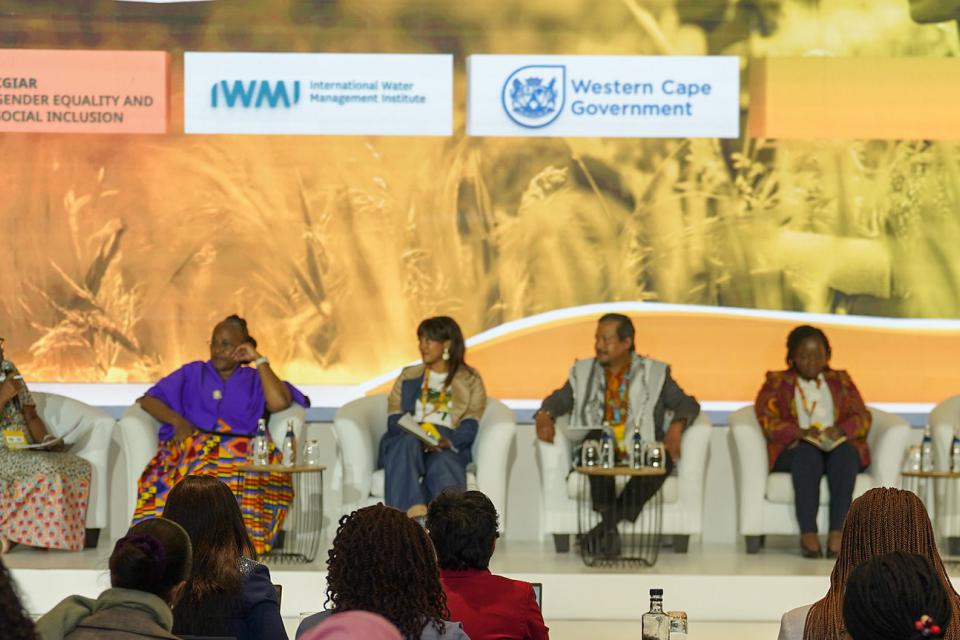
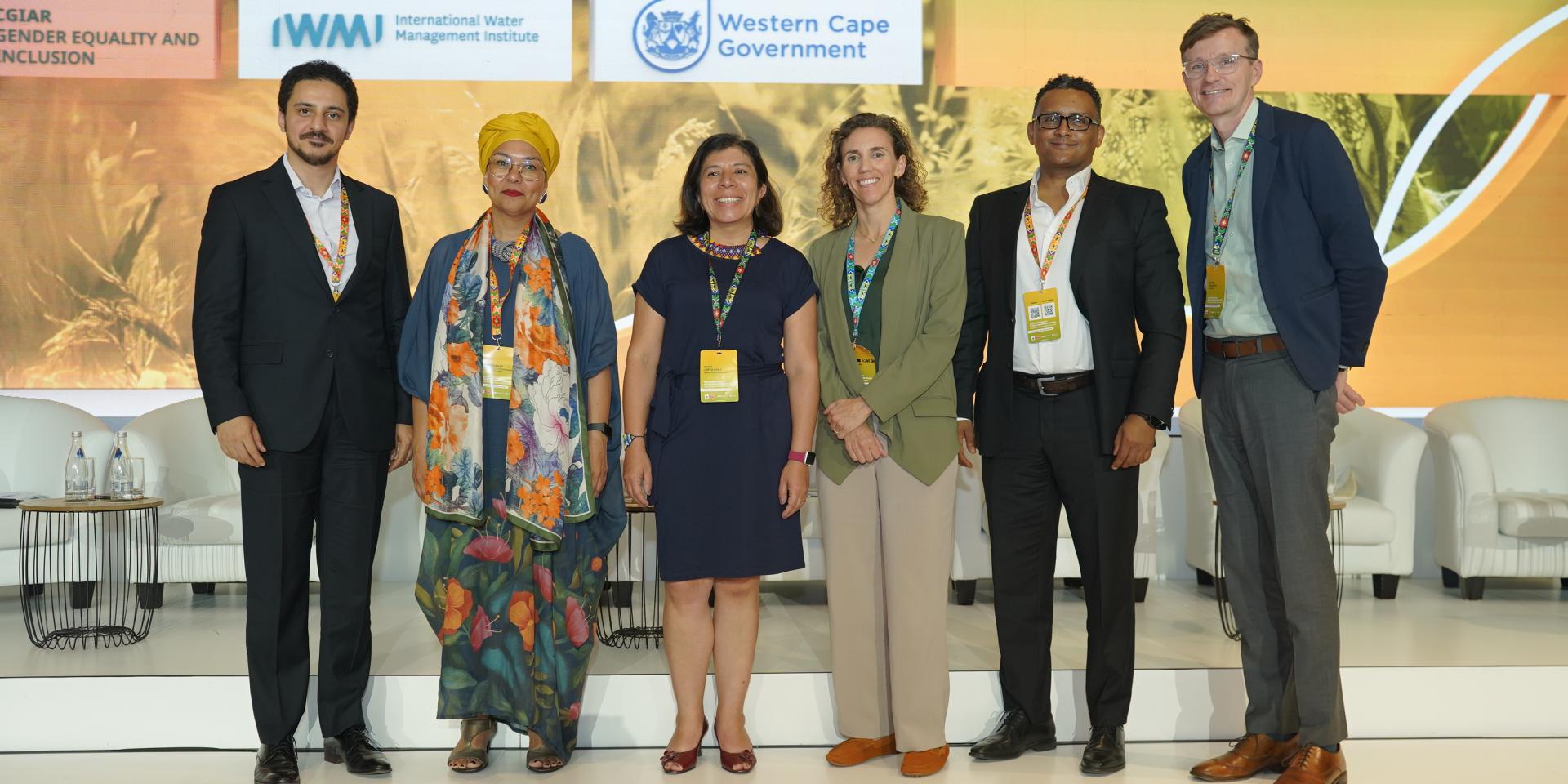
“We’ve heard over the last three days why generating evidence that informs policies and investments is important. In this plenary, we will discuss why impact on gender equality is important—how to generate it, and how to measure it,” said Diana Lopez (Senior Scientist, Gender and Impact Assessment, CGIAR), who opened a high-level plenary session at the recent Gender conference.
The session, during the CGIAR Gender in Food, Land and Water Systems Conference held in October at Cape Town, brought together speakers from CGIAR, the World Bank, the Abdul Latif Jameel Poverty Action Lab, the Gates Foundation, and the University of Cape Town.
These panelists explored how to generate and measure impacts of research on gender equality and social inclusion in food systems.
Impact on gender equality means tangible changes for women
Inga Jacobs-Mata (Senior Program Director, Water, Growth and Inclusion, IWMI), whose institute aims ‘to reduce global inequality by ensuring women, youth, and marginalized groups have equal access to the use and management of water resources,’ noted that real impact shows up as shifts of power.
These shifts can show up in moving from participation to leadership, or from economic marginalization to agency and decision-making.
For example, CGIAR’s Ukama Ustawi initiative has supported more than 70,000 women agribusinesses with gender-responsive irrigation models, inclusive finance, peer-to-peer mentoring, and improved market access. The initiative has increased household incomes across the region.
Malik Abaddi (Evaluation Senior Lead, OCP Nutricrops and Policy Manager/Delivery Lead, UM6P-J-PAL Applied Lab for Africa) described impact as visible changes in access to and control over resources, agency in household and farm decisions, and economic outcomes.
“Women are in the room. They are in the data. And they are in the decision-making loop,” said Abaddi.
Similarly, Michael O’Sullivan (World Bank Africa Gender Innovation Lab) believes that impact goes beyond participation—rather, it is about ensuring that women can benefit fully and equally from agriculture and food systems.
“Impact happens when the innovations we co-create with partners tackle underlying constraints, and when we are intentional in measuring how they work and what they cost,” O’Sullivan said.
Abaddi also mentioned the importance of targeting both men and women within households, and using bundled services (combining social and technical innovations or support), which tend to be more effective for increasing empowerment and agency than stand-alone interventions.
Investing in scalable partnerships and real decision-making power
The Gates Foundation recently announced it would invest $200 billion over the next 20 years in Africa for people’s wellbeing—women’s empowerment is at the heart of agricultural development, which remains priority for the foundation.
“Achieving gender equality is not a ‘side’ outcome, and not just an end in itself. It is central to transforming agri-food systems,” said Lynn Schneider (Senior Program Officer).
Schneider noted that the funding is a unique opportunity for partners to be more strategic and impactful, emphasizing the need to identify what works for women in agriculture to create impact, and what is cost-effective to scale in partnership with others.
Drawing on the work done by the Africa Gender Innovation Lab of the World Bank, O’Sullivan presented examples of innovations that have proven to be effective to close gender gaps in agrifood systems. These include traditional extension services combined with personal initiative training or the provision of childcare services.
Reflecting on a World Bank Research Observer paper reviewing the status of women in South Asia over four decades, Yonas Alem (Research Professor, School of Economics, University of Cape Town) noted that despite rising family incomes, women’s social and economic status has remained stagnant.
“What we learn from successful case studies is that institutional setups matter,” said Alem. “We often focus on material needs like access to land, but we must also reform the social justice systems—like land tenure—that underpin inequality.”
Translating complex results into actionable advice for policy
Because policy remains an important part of lasting systemic change, panelists emphasized the need to rapidly translate research evidence into actionable policy.
Schneider called on donors to continue investing in generating evidence while remaining flexible to quickly apply the resulting lessons. “Let’s be super adaptive, constantly learning, and encouraging our grantees to keep learning,” she urged.
Researchers were also encouraged to communicate more effectively with policymakers through concise and digestible briefs that make complex findings accessible.
Malik Abaddi added that this should start early, and have an evaluation that already has policy questions “baked in.” “We can avoid this by bringing the right people to the table early in the process,” he said.
Impact requires intentionality, inclusion, institutional transformation
Jacobs-Mata acknowledged how CGIAR plays a critical role in generating globally relevant research and evidence for these transformative outcomes. Institutionally, she said, “the real innovation is how we hardwire equity into our institutional DNA—creating ripple effects that shape broader impact.”
The session overall brought home for participants that achieving impact for gender equality really takes more than data, whether that is generating or measuring it. It requires intentionality, inclusion, and institutional transformation.
True impact will only be achieved when women are not ‘just’ participants in food systems, but equal leaders, innovators and decision-makers shaping their own future and that of the food systems.