Opening plenary sets tone for action on gender equality in food, land and water systems
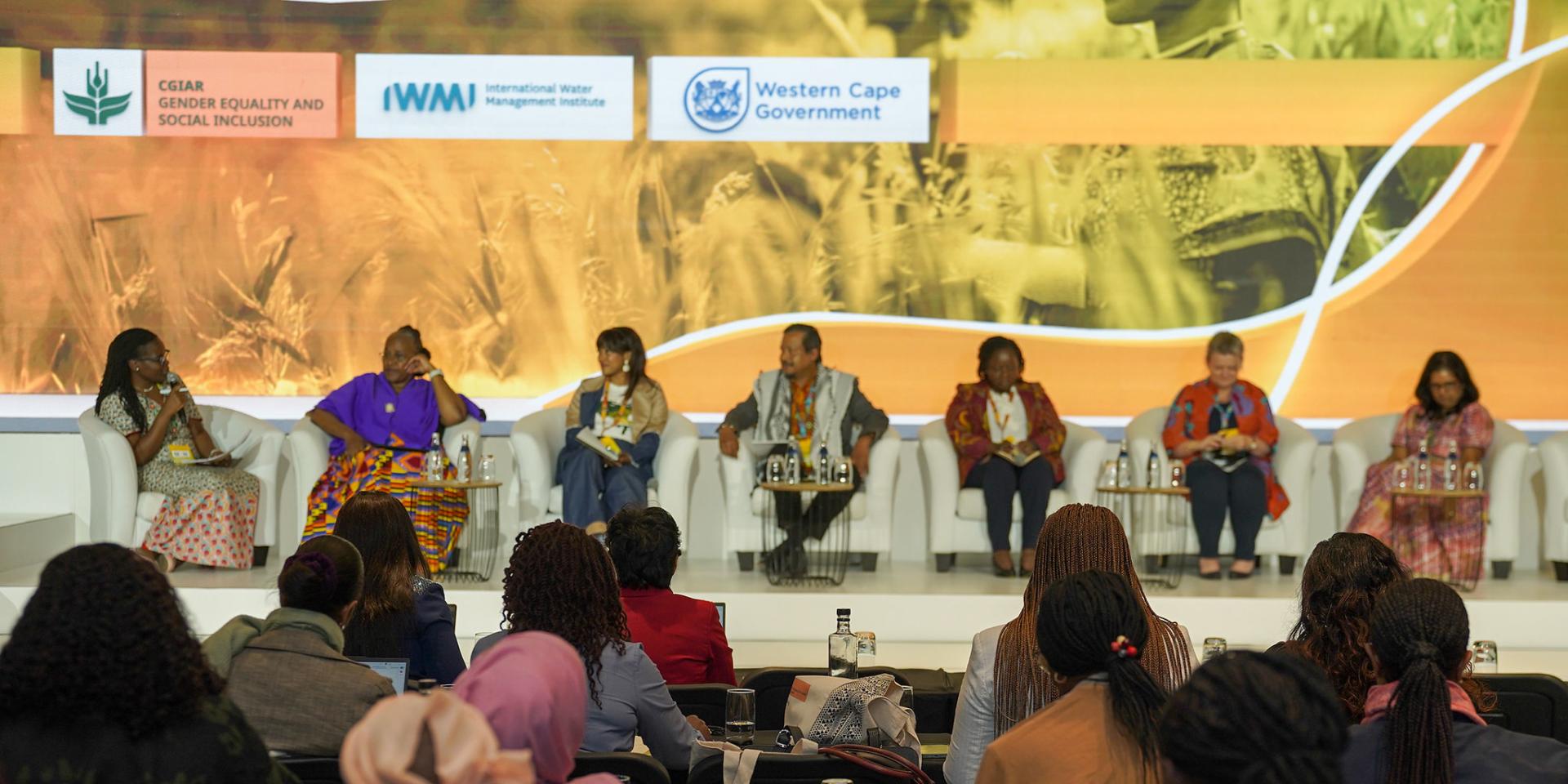
The recent Gender Conference in Cape Town opened with calls from the diverse speakers to take on a collective responsibility to move from analysis to implementation, from principles to practice change.
Conference opens with call to action
The 2025 Gender Conference in Cape Town (South Africa), Accelerating Equality in Food, Land, and Water Systems: Driving Solutions through Evidence and Learning, opened on 7 October with a powerful call to action: to move from analysis to implementation, and from inclusion in principle to equality in practice.
The conference brought together researchers, policymakers, funders, practitioners and community voices committed to closing gender gaps and driving inclusive innovation.
Speakers from across the CGIAR network, government, civil society, and Indigenous and youth communities emphasized collaboration, evidence and solidarity as essential pathways to accelerate equality across food, land and water systems.
Grounding the conversation: beginning with a traditional blessing
The opening ceremony, led by Tauriq Jenkins (Chair, A|Xarra Restorative Justice Forum and Convenor, Save our Sacred Lands) offered a deeply symbolic start. Through a traditional blessing—"the return of our mother tongue to the soil”—Jenkins reminded participants that equality and justice begin with the land, language, and the recognition of Indigenous knowledge systems.
His words set a reflective tone, urging participants to center cultural heritage and Indigenous custodianship in conversations about sustainable food and water systems.
Guiding themes of collaboration, learning and networking
Vivian Atakos (Lead, Global Engagement and Policy) welcomed participants as a live poll illuminated the conference’s diversity of voices and expectations—learning, collaboration and networking emerged as shared priorities.
Henry Roman (Country Representative, IWMI South Africa) opened the plenary by highlighting the central role of water in food security and IWMI’s gender equality and social inclusion strategy: “Water justice and gender equality are intertwined foundations of sustainable development.”
Nicoline de Haan (Director, CGIAR Gender Equality and Inclusion Accelerator) extended gratitude to partners including IWMI, the Western Cape Government, and the South African Department of Agriculture. She framed the conference as a space for open, equitable exchange, “a place where we can be unapologetically ourselves, where young researchers can present their work, and where collaboration becomes the catalyst for innovation.”
De Haan also invoked the G20’s guiding themes of solidarity, equality, and sustainability, principles that also define this year’s Gender conference.
“We have done a lot of analysis,” she noted. “Now, let’s move to solutions. With the 2026 International Year of the Woman Farmer ahead, we have an entire year to make the world more just and fair.”
Partners’ voices: gender equality “not a side program”
Representing the Western Cape Government Department of Agriculture, Bongiswa Matoti (speaking on behalf of Head of Department Mogale Sebopetsa) emphasized that “gender equality is not a side program; it is central to economic inclusion and food security.”
She reflected on South Africa’s lessons from the ‘Day Zero’ drought and the COVID-19 pandemic, when women were at the forefront of resilience and community recovery.
“Women are at the center of all solutions. Access to land and water is the foundation of resilience, and we must ensure women and youth are active participants in these systems,” she said.
Dhesigen Naidoo (Member, CGIAR Integrated Partnership Board) placed these discussions in the context of today’s global polycrisis of climate disruption, conflict and social inequality. “Agriculture may be the instrument that gets us over the edge,” he said. “Empowering women is not just a gender issue—it is a development imperative.”
Naidoo praised CGIAR’s leadership in embedding gender equality and social inclusion across its portfolio: “We must invest in knowledge, innovation and the courage to reshape our societies so that equality becomes what we achieve, not what we aspire to.”
Ismahane Elouafi (CGIAR Executive Managing Director) called for increased investment in inclusive finance and digital innovation. “We must listen to farmers themselves—especially women and youth—and design programs that reflect their realities,” she said. “Let this moment be a springboard for progress in the years ahead.”
Panel reflects on turning vision of equality and inclusion into action
A dynamic panel then brought together voices from research, policy, advocacy, and youth leadership: Nicoline de Haan, Mikateko Joyce Maluleke, Mwaka Namukonda, Surita Sandosham, Tauriq Jenkins, and Nancy Laibuni.
Persistent social and structural barriers
Panelists explored the social and structural barriers that continue to limit women’s and young people’s participation in agrifood systems:
- Mikateko Joyce Maluleke (Director-General of the Department of Women, Youth and Persons with Disabilities) called for education and access to land and water as fundamental rights.
- Mwaka Namukonda (Executive Coordinator, Consortium of African Youth in Agriculture and Climate Change) urged: “We must move beyond tokenism. Give young people responsibility to initiate and lead. That’s how we break the cycle of exclusion.”
- Surita Sandosham (President and CEO, Heifer International) reminded the audience that “equality cannot be an afterthought; it must be built in from the start.”
- Tauriq Jenkins emphasized the need for a decolonized framework, cautioning against corporate “Indigenous washing” and calling for a genuine return to community custodianship of land and water.
Examples of catalytic funding and policies
Nancy Laibuni (Kenya’s President’s Council of Economic Affairs) underscored the power of participatory policy processes. “Every policy must go through public participation; youth, women and partners must be part of shaping it,” she said. “We need to communicate our research in ways that inform real decisions.”
Sandosham shared examples of catalytic funding that has enabled women and youth innovations—from mobile apps to drone-based precision farming.
De Haan emphasized that keys to sustainable change are “understanding context, making women farmers visible, and adopting gender-transformative approaches.”
Progress must be measurable and inclusive
The panel agreed that progress must be both measurable and inclusive:
- Maluleke highlighted South Africa’s G20 themes of care work, economic empowerment, and positive masculinity as frameworks for transformation.
- Laibuni called for stronger governance mechanisms and evidence-based action plans that track gender-equality targets.
- Sandosham linked scale with sustainability: “To ensure women farmers lead thriving, resilient lives, we must work hand in hand with strategic partners across sectors.”
Sincerely centering Indigenous knowledge and marginalized people
Throughout the discussion, panellists reaffirmed that Indigenous and marginalized people must not be mere beneficiaries, but co-designers of solutions.
Jenkins reflected that “the centering of Indigenous voices must begin at inception. It will be messy and slow, but that’s the price of sincerity.”
Namukonda built on this point, reminding the audience: “We are here today because our ancestors did not destroy our land. We must integrate Indigenous knowledge with innovation to protect the ecosystems that sustain us.”
The remit: data to dialogue, research to action, evidence to equality
The opening plenary set a powerful tone for the days ahead—one of solidarity, equality, and sustainability, aligning with the core themes of South Africa’s G20 presidency. It called on participants to transform data into dialogue, research into action, and evidence into equality.
De Haan concluded that we can scale by “unlocking the potential of women.”
The message was clear: achieving equality in food, land and water systems is not only essential for justice—it is the key to building resilient, sustainable futures for all.
Related content