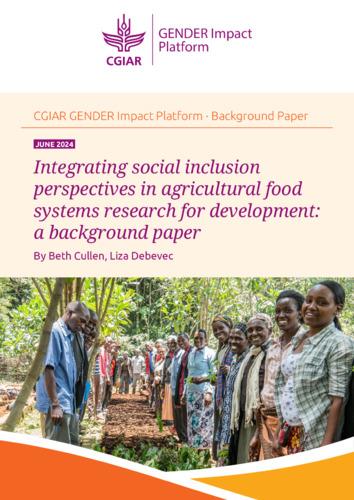
GENDER working papers
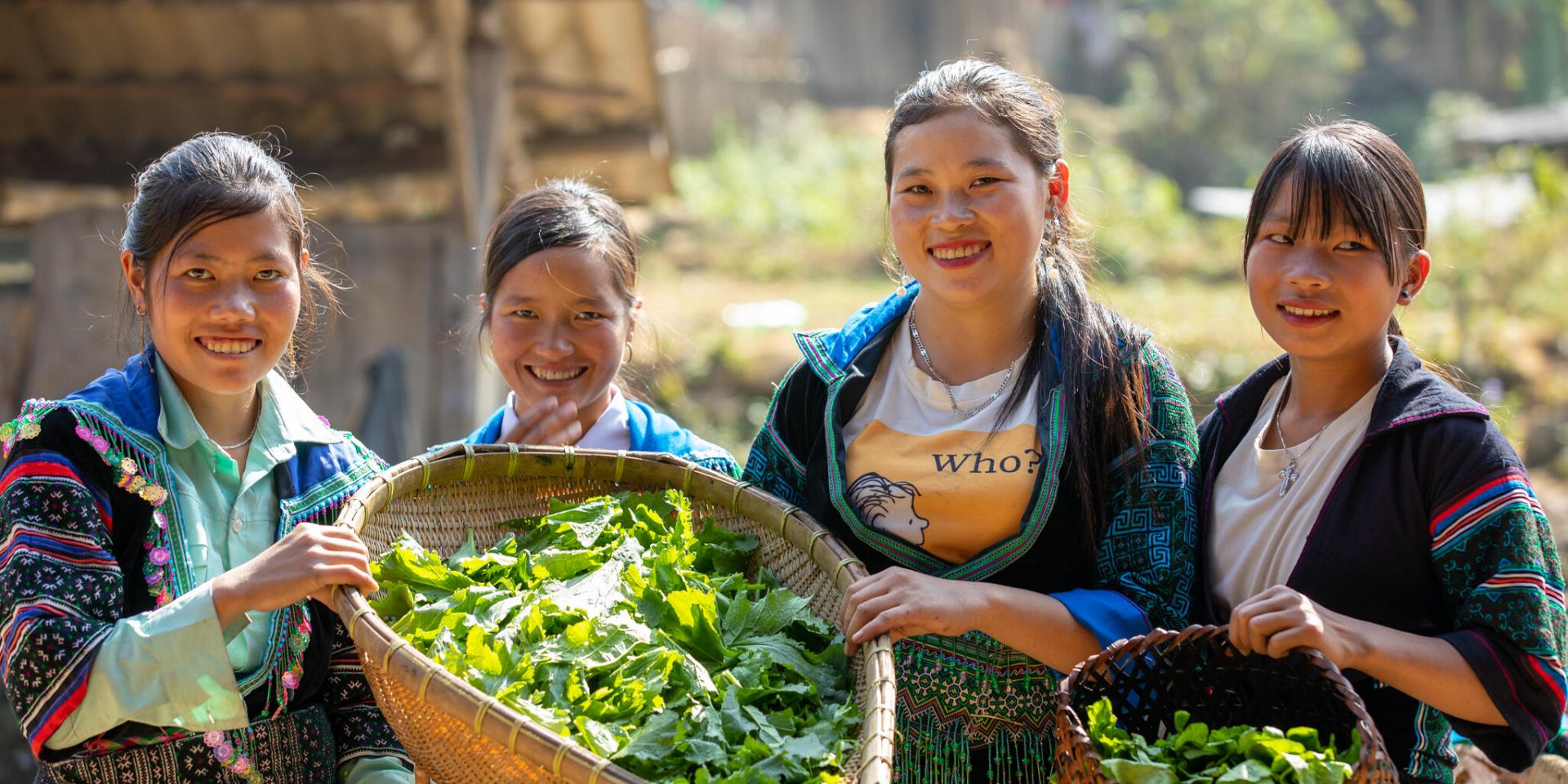 Photo: 2020 Alliance of Bioversity International and CIAT/Trong Chinh.
CGIAR Gender Equality and Inclusion publishes working papers to share emerging gender research insights and results with agriculture and food systems researchers in CGIAR and beyond. Some papers might also appeal to a wider audience, including development practitioners, funding partners or policy- makers.
The aim of the CGIAR Gender Equality and Inclusion (CGIAR GENDER Accelerator) working papers is to document and make available emerging work in order to stimulate innovations in thinking, discourse and actions on gender equality in agriculture and food systems.
Scope and format
The working papers document and present robust, high-quality gender research from CGIAR Gender Equality and Inclusion. CGIAR GENDER working papers are original research, case studies; evaluations, reviews of tools and methods, documentation of best practices, stocktakes or evidence mapping exercises, compendiums of tools, and more.
Commission, review and production
All working papers undergo an internal peer review process by CGIAR researchers, including the CGIAR GENDER Science Officer Els Lecoutere. Editorial roles are assumed by both the CGIAR GENDER Science Officer and Director Nicoline de Haan, who gives final sign-off. For more information, contact gender@cgiar.org.
Publications
Lessons on methodologies to assess women’s empowerment from two agricultural and livestock project portfolios: CGIAR Gender Equality and Inclusion Working Paper #030
Women’s collective action and its impact on their resilience in agri-food systems: a rapid evidence review: CGIAR GENDER Impact Platform Working Paper #29
Booker, F., Duffy, J., Nicolini, G., Nieto, I. N. P., Wagner, K., Verma, B., Anbacha, A. E., Puskur, R. and Kori, P. 2025. Women’s collective action and its impact on their resilience in agri-food systems: a rapid evidence review. CGIAR GENDER Impact Platform Working Paper #029. Nairobi, Kenya: CGIAR GENDER Impact Platform.
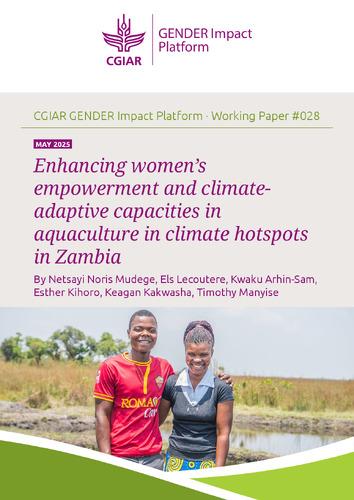
Enhancing women’s empowerment and climate-adaptive capacities in aquaculture in climate hotspots in Zambia: CGIAR GENDER Impact Platform Working Paper #28
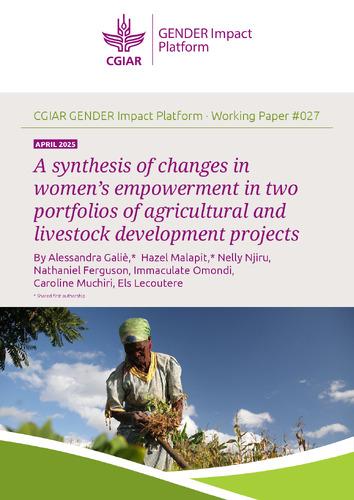
A synthesis of changes in women’s empowerment in two portfolios of agricultural and livestock development projects: CGIAR GENDER Impact Platform Working Paper #27
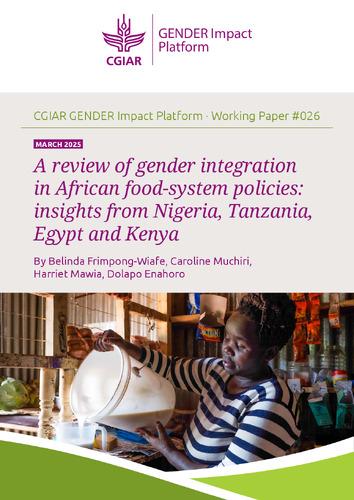
A review of gender integration in African food-system policies: insights from Nigeria, Tanzania, Egypt and Kenya: CGIAR GENDER Impact Platform Working Paper #26
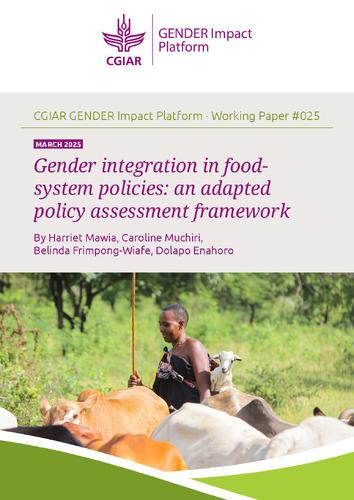
Gender integration in food-system policies: an adapted policy assessment framework: CGIAR GENDER Impact Platform Working Paper #25
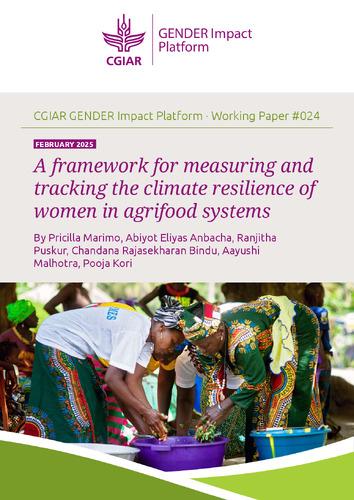
A framework for measuring and tracking the climate resilience of women in agrifood systems: CGIAR GENDER Impact Platform Working Paper #24
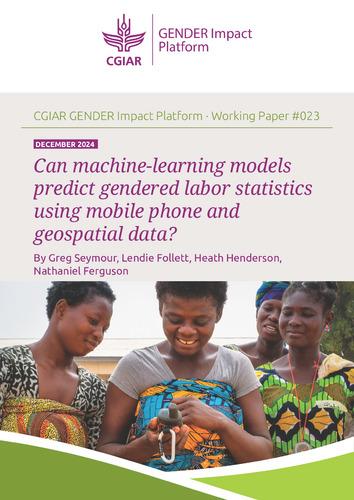
Can machine-learning models predict gendered labor statistics using mobile phone and geospatial data?: CGIAR GENDER Impact Platform Working Paper #23
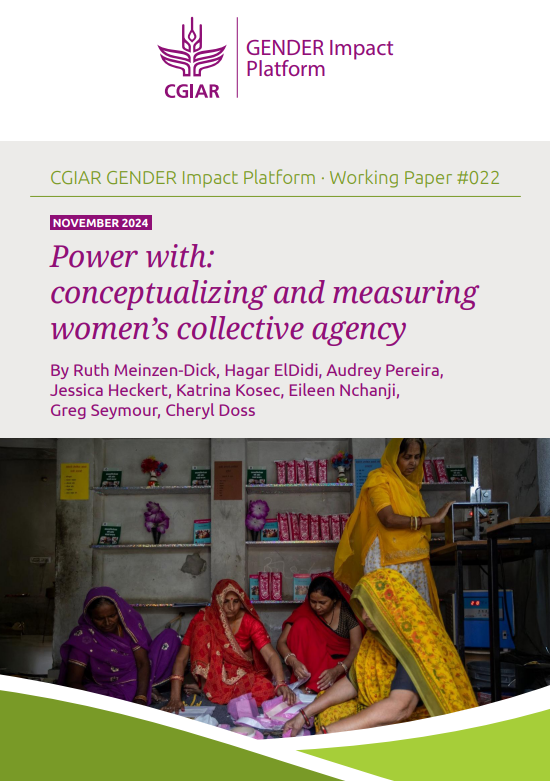
Power with: conceptualizing and measuring women’s collective agency: CGIAR GENDER Impact Platform Working Paper #22
Meinzen-Dick, R., Hagar, E., Pereira, A., Heckert, J., Kosec, K., Nchanji, E., Seymour, G. and Doss, C. 2024. Power with: conceptualizing and measuring women’s collective agency. CGIAR GENDER Impact Platform Working Paper 22. Nairobi, Kenya: CGIAR GENDER Impact Platform.
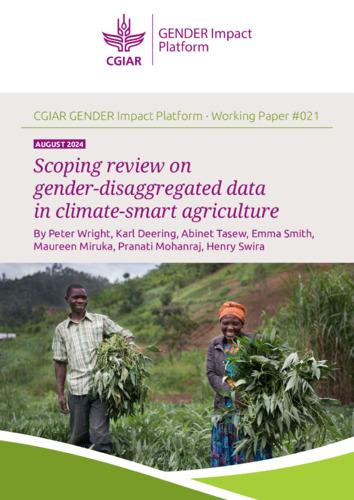
Scoping review on gender-disaggregated data in climate-smart agriculture: CGIAR GENDER Impact Platform Working Paper #21
A review of social inclusion guidelines, methods and tools: CGIAR GENDER Impact Platform Working Paper #20