ILRI. 2010. How to pitch a livestock science project for funding. Video recorded at the ILRI APM 2010, held at Addis Ababa, Ethiopia, April 14-17, 2010. Nairobi (Kenya): ILRI.
Bhatia, R.; Amerasinghe, U.; Imbulana, K. A. U. S. 1994. Indicators of agricultural performance in the Muda Irrigation Scheme, Malaysia. In International Irrigation Management Institute (IIMI). The Tenth Internal Program Review, Colombo, 7-10 November 1994. Volume I-A. Papers for discussion. Colombo, Sri Lanka: International Irrigation Management Institute (IIMI). 46p.
Sally, H. 1992. Mogtedo: the sociotechnical evolution of an overexpanding irrigation scheme. In International Irrigation Management Institute (IIMI). Advancements in IIMI's research 1992: a selection of papers presented at the Internal Program Review. Colombo, Sri Lanka: International Irrigation Management Institute (IIMI). pp.51-77.
Mukherji, Aditi; Facon, T.; Molden, David; Chartres, Colin. 2010. Growing more food with less water: how can revitalizing Asias irrigation help? Paper presented at the Water Crisis and Choices, ADB and Partners Conference, ADB HQ, Manila, Philippines, 11-15 October 2010. 23p.
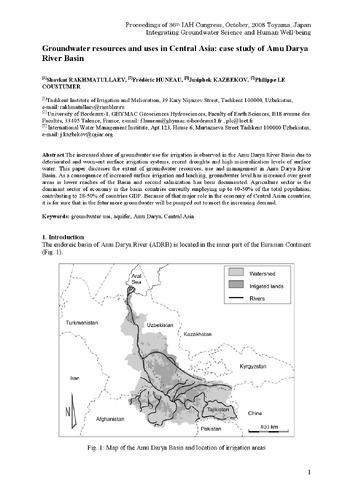
Rakhmatullaev, S.; Huneau, F.; Kazbekov, Jusipbek; Le Coustumer, P. 2008. Groundwater resources and uses in Central Asia: case study of Amu Darya River Basin. Paper presented at the 36th IAH Congress, Integrating Groundwater Science and Human Well-being, Toyama, Japan, 27-31 October, 2008. 8p.
Pradhan, U. 1994. State expectations and local interests: the context for irrigation management transfer in Nepal. In IIMI; Wuhan University of Hydraulic and Electrical Engineering. International Conference on Irrigation Management Transfer, Wuhan, China, 20-24 September 1994. Draft conference papers. Vol.3. Colombo, Sri Lanka: International Irrigation Management Institute (IIMI); Wuhan, China: Wuhan University of Hydraulic and Electrical Engineering. pp.175-183.
Biggs, Trent; Ahmad, Mobin-ud-Din. 2004. ET Krishna Basin. Print out of powerpoint presentation made at the Observing river basins from space: why is it important for IWMI - A Remote Sensing and GIS (RS/GIS) Workshop held at the International Water Management Institute, Colombo, Sri Lanka, 28 June 2004. RS/GIS training materials. 11p.
International Irrigation Management Institute (IIMI). 1998. National Water Conference on Status and Future Directions of Water Research in Sri Lanka, BMICH, Colombo, Sri Lanka, 4-6 November 1998. Session 16: Watershed management III; Session 17: Water scarcity; Session 18: Efficient irrigation. Research papers presented. 155p.
Lanka International Forum for Environment and Development (LIFE-WRU); Global Water Partnership (GWP); International Water Management Institute (IWMI) 1999. Regional Workshop to Develop a South Asia Water Vision: country papers and list of participants, Colombo, Sri Lanka, 27-29 June 1999. Colombo, Sri Lanka: Lanka International Forum for Environment and Development (LIFE-WRU); Colombo, Sri Lanka: Global Water Partnership (GWP); Colombo, Sri Lanka: International Water Management Institute (IWMI). v.p.
Bhattarai, M.; Sakthivadivel, R.; Hussain, Intizar. 2002. Irrigation impacts on income inequality and poverty alleviation: policy issues and options for improved management of irrigation systems. Colombo, Sri Lanka: International Water Management Institute (IWMI). vi, 29p. (IWMI Working Paper 039) https://hdl.handle.net/10568/39287
Klinkenberg, E.; Huibers, F.; Takken, W.; Toure, Y. T. 2002. Water management as a tool for malaria mosquito control? Irrigation and Drainage Systems, 16(3):201-212.
Cheema, Muhammad Jehanzeb Masud; Bastiaanssen, W. G. M. 2012. Local calibration of remotely sensed rainfall from the TRMM satellite for different periods and spatial scales in the Indus Basin. International Journal of Remote Sensing, 33(8):2603-2627. doi: http://dx.doi.org/10.1080/01431161.2011.617397
Clement, Floriane; Pradhan, P.; van Koppen, Barbara. 2019. Understanding the non-institutionalization of a socio-technical innovation: the case of multiple-use water services (MUS) in Nepal. Water International, 44(4):408-426. doi: 10.1080/02508060.2019.1600336