Exploring conference Theme 3: Effective strategies and innovations for enhancing resilience and livelihoods in food, land and water systems
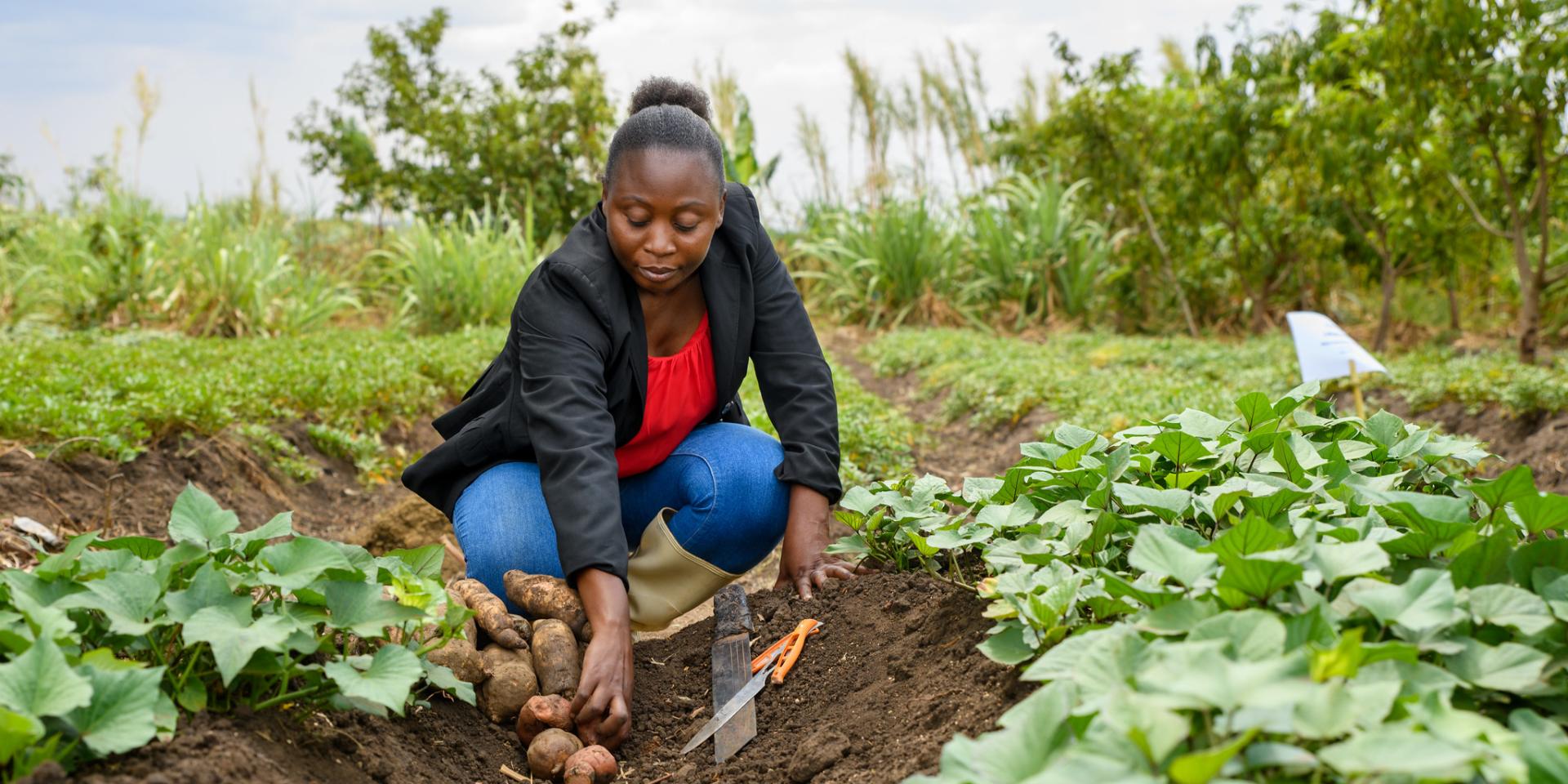 Photo: Emmanuel Museruka / CIP
Theme 3 of the upcoming international conference 'Accelerating Equality in food, land and water systems; Driving solutions through learning and impact' will focus on effective strategies and innovations for enhancing resilience and livelihoods in Food, Land and Water Systems. A question-and-answer with Theme 3 leader Trent Blare.
We sat down with Trent Blare, Country Manager for the International Potato Center (CIP) in Ecuador and leader of Theme 3 for the Gender in food, land and water system conference 2025 to discuss how structural barriers limit the resilience of resource-poor women, youth and socially excluded groups and their ability to adapt to climate risks and other challenges. Trent discusses the boundary-pushing research that has been submitted under Theme 3, bringing together a variety of approaches that he hopes will spark richer debate on how to design technologies, extension systems and programs that truly include everyone.
Tell us a bit about your background and research interests.
My background is in agricultural economics, with a focus on value chains, market development and inclusion in food systems. Over time, my work has increasingly turned toward issues of gender, youth, intersectionality and Indigenous Communities here in the Andes.
Why is Theme 3 so important in the context of agricultural transformation?
Theme 3 is about inclusive technologies and innovations. CGIAR has always been known for developing technologies such as improved varieties and better practices—from the Green Revolution onwards. Historically, innovations were focused on improving production and confronting food insecurity; but now we have the additional challenges of climate change where we have to work hand-in-hand with communities to face this threat that will affect food security and nutrition.
But while technologies are essential for addressing challenges like food insecurity, climate change and nutrition, we have not always considered how we could inclusively incorporate these innovations in our work; they don’t always reach or benefit everyone equally. If we don’t consider how everyone can use the technology, how they access information about the technology, or how it will work in communities, cultures and different social norms, then adoption of a technology won’t be successful.
So, Theme 3 looks at how to bridge that gap—ensuring technologies are not only technically sound, but socially inclusive.
What kinds of contributions are you hoping to see under this theme at the conference?
We’ve got an exciting mix: scientific research, capacity-building programs and panel discussions. There has been a lot of work looking at differences between men and women and technology adoption, and how we can better reach women. But I have also found some really interesting abstracts looking at intersectionality.
Much of the work being presented in Theme 3 goes beyond the traditional focus on women to look at intersectionality—considering the experiences of youth, young women compared to older women, and even the role of men in the empowerment of women to help shift social norms. We are pushing the envelope to develop a more transformative conversation.
Methodologically, there’s also diversity in the work being presented. We’ll see randomized control trials that provide rigorous evidence of impact alongside qualitative research that gives deep insights into adoption barriers for certain technologies and cultural contexts. Bringing these approaches together will spark debate on how to design technologies, extension systems and programs. I think it’s going to be really fascinating.
Why is it critical to center women, youth and socially excluded groups in resilience-building?
Well, there is no question that these are the groups that are disempowered, right? And that disempowerment is different in different contexts, across countries or even within a country. Women still face major challenges in accessing new technologies or information, and they are not always considered when technologies are developed. Youth, in many places, see few opportunities in agriculture, leading to migration. Without them, we can’t secure long-term food security.
So the discussion about men and groups that traditionally are more empowered is to help them be involved in the process and understand the need to include women and youth and other socially marginalized groups. If they aren’t part of the conversation, social norms won’t shift. In some cases, men would like to be involved in other activities such as helping with childcare— something that is sometimes seen as less than desirable due to social norms, right? So, if we can change some of these social norms, it benefits both men and women.
So, we know these groups are traditionally disadvantaged; there is no debate about that. But we have to include everyone in the discussion, alongside transformative research, to change systems.
In which ways can traditional knowledge and local leadership shape more sustainable and inclusive responses?
A few decades ago, scientists and researchers were seen as the experts when it came to developing technologies and bringing them to communities.
However, increasingly, we see that traditional knowledge—planting systems, soil management practices or crop diversity—offers resilience lessons we can’t ignore. For example, Indigenous Communities often maintain practices that help withstand climate shocks.
At the same time, local leadership is critical. Even if women’s groups want to adopt an innovation, without local leaders’ support it often won’t scale. Working directly with farmers, extension systems and leaders allows us to combine scientific advances with traditional practices.
And one of the beauties of CGIAR, as an international organization, is that we can share across regions, learning from tribal leadership structures in Africa to Indigenous leadership in the Andes. So, although we work across different contexts, there are often commonalities in traditional knowledge that we can apply.
What strategies or innovations have you seen make a real difference?
One example from a recent project is that we are using traditional tuber crops to counter climate change and control diseases. We planted native potatoes with a traditional Indian tuber called ‘mashua’ that has both nutritional and medicinal values and is often found in women’s home gardens. By companion-planting native potatoes with mashua we were able to control whiteflies, effectively reducing infestations, while also reintroducing diverse, nutrient-rich food into diets.
This approach has multiple benefits: fewer chemicals, stronger resilience, more nutritious diets, and recognition of women’s role in conserving biodiversity. When one woman insisted on trying it, despite her husband’s doubts, the resulting abundant harvest convinced her whole household of the benefits. Now we’re also exploring how to bring these foods back into local markets. This project shows how blending traditional knowledge with new science can transform livelihoods.
Related content