Solar Pumps as Micro-Enterprises for Women Leveraging Bihar’s Self-Help Groups for Equitable Irrigation Access

Abstract
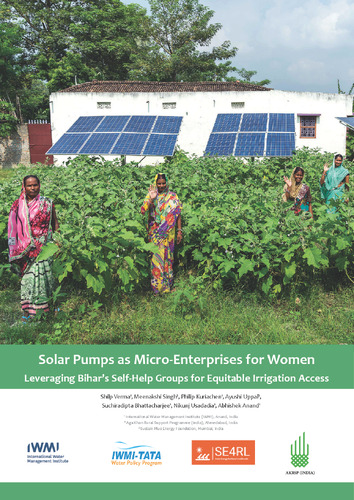
This brief presents an action research pilot in Lohsari village of north Bihar, India, implemented by the Aga Khan Rural Support Program, India (AKRSP-I), with support from the IWMI-Tata Water Policy Program and the Solar Energy for Rural Livelihoods (SE4RL) project. In India’s eastern Gangetic plains, solar pumps can offer clean energy for pumping water – to replace highly polluting and costly diesel-based irrigation. However, highly fragmented land holdings make investments in individual solar pumps unattractive and unviable. Since 2016, IWMI and AKRSP-I have been working in north Bihar to pilot solar irrigation entrepreneurs – who can deliver high quality and affordable solar irrigation as a service through a solar pump coupled with a network of buried pipes. Through the flagship rural livelihoods initiative, Jeevika, the government of Bihar has also promoted women Self-Help Groups (SHGs) across the state – to promote micro-saving and micro-lending. As these SHGs mature, they are also encouraging women members to take up micro-enterprises to enhance their incomes. Through this pilot, we are field testing a model that offers solar pumps as a micro-enterprise for SHG women. The innovative pilot aims to demonstrate how such enterprises can eliminate diesel use, boost women’s economic agency, and enhance irrigation coverage.