When women lead, change and resilience follow: a story from Makaltala
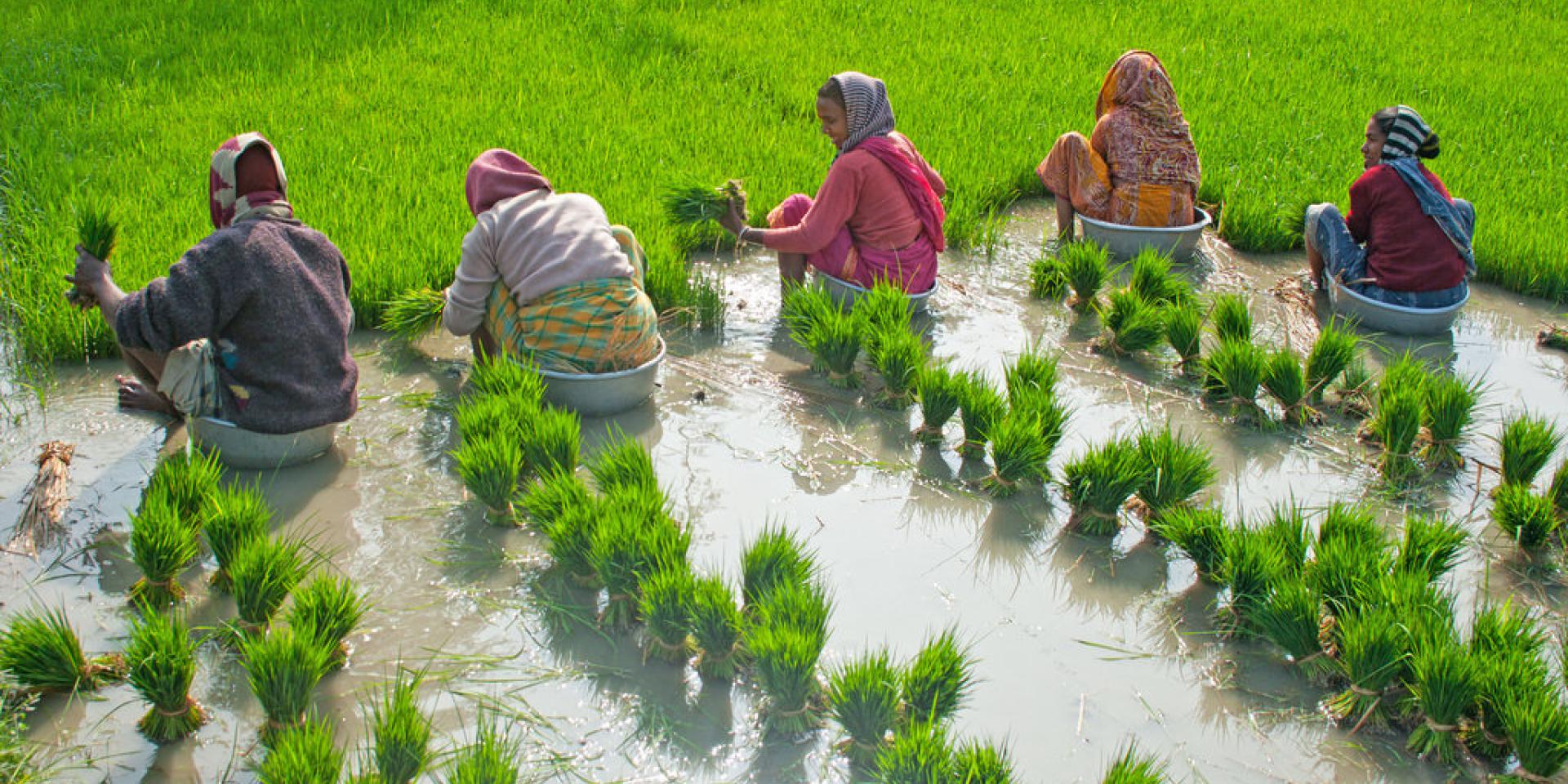 Photo: Bioversity International
In Makaltala, a village in the North 24 Parganas district of Bengal, women farmers have been a part of a learning lab piloting Socio-Technical Innovation Bundles that has resulted in real change in income, capacity and confidence. Rather than becoming victims of climate change, these women farmers have created pathways to strengthen their climate resilience and have changed what they believed to be possible for themselves, their families and their community.
“We’ve been part of many projects before, but never one like this,” said Lakhhi Didi as tears welled in her eyes.
Lakhhi Sardar, a Munda Adivasi woman, is one of six lead farmers who each guide a group of 30 women farmers in the flood-prone Makaltala village in North 24 Parganas district of Bengal, India. Since 2023, this village has been a learning lab for piloting Socio-Technical Innovation Bundles (STIBs) under the CGIAR Gender Equality Initiative. STIBs focus on systematic co-design, participatory implementation and monitoring of a suite of locally relevant agricultural technologies, and institutional and social innovations. The goal of STIBs is to empower women as leaders and agents of climate resilience. The six women leaders were identified through a social network analysis and, together with the women in their communities, they are shaping the future of farming in their village.
Living in the shadow of flooding
Each year, the agricultural lands in Makaltala are submerged under 4 or 5 feet of water during the monsoon season from July to December, for as long as 4 to 6 months. With ineffective drainage, farming becomes nearly impossible.
“We used to grow rice, but we’ve given it up due to the flooding,” says Dulal Sardar, a community leader.
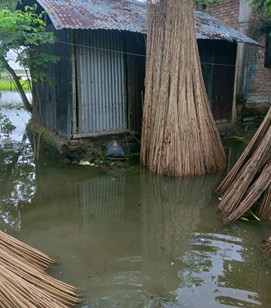
Water logged fields in Makaltala, September 2024. Photo: CGIAR
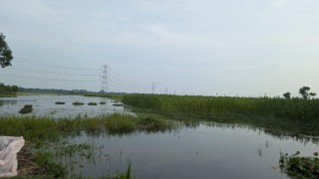
Water logged fields in Makaltala, July 2025. Photo: CGIAR
As paddy fields became uncultivable due to this prolonged inundation, the women started trying different strategies to overcome the flooding challenge. For example, jute is one of the few crops that can be grown in inundated conditions. Organizations such as the Society for Equitable Voluntary Actions (SEVA) provided training in growing jute. But many of the women farmers started goat rearing for a more resilient and quicker source of income. A rapid situational analysis conducted by SEVA in 2023 under the CGIAR Gender Equality initiative revealed women’s strong interest in expanding and strengthening their goat-rearing skills. The women do not own land and have less control over income from crops. But they do tend to own small livestock, such as poultry and small ruminants, and control their income from this livestock. However, without any technical support, their goat-rearing practices remained largely traditional.
Enhancing goat husbandry skills offered a strategic entry point for building the women’s economic agency in the face of climate stress.
The monsoon trap: distress sales
But even goat rearing is not completely risk free under stressed climatic conditions. When floods arrive, the goat sheds become uninhabitable, pests and disease attacks intensify, and grazing is not possible. Often, in these conditions, women are forced to sell their goats. At these time, the women become vulnerable to distress sales, where middlemen offer arbitrary prices for the goats—regardless of their size, age or health. With little access to markets and little power to negotiate, women mostly accept whatever price is offered to them.
To disrupt this cycle, the Gender Equality Initiative partnered with the Indian Council of Agricultural Research’s Indian Veterinary Research Institute (IVRI) to introduce purebred Black Bengal goats—a high-value, locally adapted breed—to Makaltala. IVRI provided the women with training on scientific feeding practices, vaccination and basic veterinary care, equipping them with the tools and knowledge to make informed decisions and improve their livestock-based livelihoods. The women were also trained in how to use weighing scales to assess the value of their goats to enable them to try to negotiate fair prices.
Collective action pays off
Over the following 12 to 14 months, many Black Bengal goats attained an average weight of 10 to 13 kilograms. But as the monsoon season approached, so did the women farmers’ anxiety.
“What if the floods come again? Where will we keep the goats? How will we feed them?”
The fear of another round of distress sales was real. Many women began planning to sell their goats, worried they would not be able to manage them through the rains. But the lead farmers, with support from SEVA, urged the farmers to wait and sell their goats collectively.
“We were actively exploring possible market linkages so the women could earn fair prices,” said Avik Mitra from SEVA.
After weeks of efforts by SEVA, IVRI and Passing Gifts Private Limited, a local trader agreed to visit the village, assess the goats’ quality and explore the possibility of a bulk purchase.
The trader offered ₹200 per kilogram for female goats and ₹350 per kilogram for male goats. However, many women were hesitant to bring their goats for inspection to the trader.
At first, this was confusing for SEVA. “It was a good rate, especially considering that it was the off season. But the women didn’t seem convinced at first,” said Avik and Kutub of SEVA who were scouting potential buyers. They had also tried to negotiate selling the goats with local slaughterhouses, and no one was offering a comparable rate.
However, most women had assumed the price offered was for the whole goat and not per kilogram.
“Until now, the goats has been sold at arbitrary, lump-sum rates. Once they understood they’d be paid by weight—and that many had two or three fully grown goats—the excitement was real,” Avik recalls.
Confusion gave way to confidence. For the first time ever, women lined up eagerly to weigh their goats.
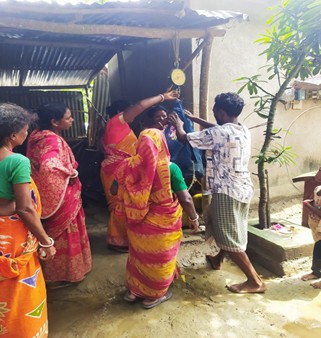
Women weighing their goats. Photo: SEVA
Informed decisions, new strategies
The women reported that, previously, they had typically earned ₹1,200–1,700 per goat regardless of the size. But following a weight-based pricing, they made ₹2,000–2,500 per goat, which is a 47– 67% increase in income per goat—a substantial gain driven by a simple shift in sales practice.
With this new experience, the women started strategizing and planning.
“Next time, I’ll plan so that the goats mature at the right time for the peak season,” said Mamata Sardar.
Her sister-in-law Aparna added, “I will keep three of my goats through the flood and sell them during the September festivals.”
The trader promised to return before the festival season in September or October, when prices typically spike.
Socio-technical innovation bundles: an approach for gender-responsive innovation
The Makaltala learning lab offers a compelling case of how real change can happen in a short period by defining desired outcomes and impacts and then working backwards to ensure comprehensive, multi-dimensional support at the right time. They developed context-specific and feasible solutions that included relevant, bundled innovations—in this case, Black Bengal goats plus scientific management practices plus capacity building plus market information and linkages plus collective action plus peer learning equaled an increase in income and empowerment. The Makaltala learning lab also created safe, inclusive spaces for women to experiment, support one another and lead from the front.
And while earning higher income is a big win, the real shift goes deeper: it is about confidence, it is about women making informed choices, it is about changing what women believe is possible for themselves, their families and their community.
The Makaltala learning lab is a living testament to the potential of the STIBs approach when it is grounded in local realities and led by women.
As new challenges emerge, so too will innovations as we continue this journey of women-led pathways for strengthening climate resilience.