Farmers in climate–gender hotspots need policy support to survive and thrive
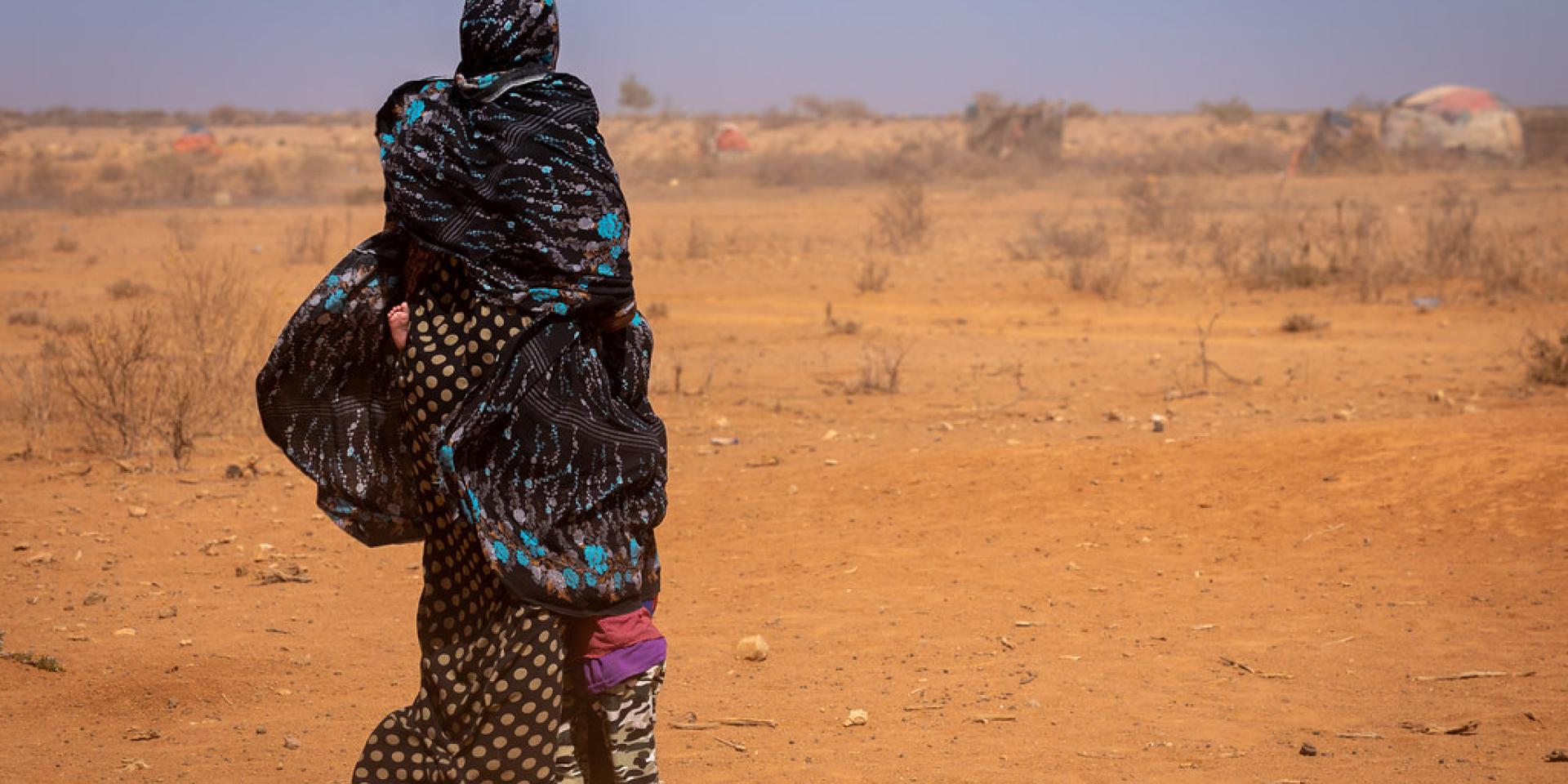 ©UNICEF Ethiopia/2022/Mulugeta Ayene
In 2022, The CGIAR GENDER Impact Platform mapped where women involved in agri-food systems were most vulnerable to climate risks. Policymakers and donors need to access such data when they are making decisions about where to prioritize scarce resources.
Lucy lives in a pastoral community in north-eastern Kenya. The region is semi-arid, and used to get rains in April. Together with her husband she keeps goats, but now she is very worried: it hasn’t rained properly for some years and there is little water nearby for cooking or drinking, let alone the goats.
Lucy must walk more than two hours to find water and she constantly feels scared and exhausted. She can’t get milk from their goats anymore and they are weak and constantly need her care.
Although Lucy really wants to go to a meeting about how she can improve the feed quality for their goats, she realizes she won’t have time. And she’s not sure anyway if they have the money to pay for anything new, when they barely have enough food to put on the table. They used to have a much larger herd, but her husband had to sell some of the goats so they could manage.
This is a fictional story based on the real lives of smallholder farmers in north-eastern Kenya during the 2020–22 drought, which many called the worst water crisis in the last 40 years. The drought left millions of people lacking stable access to safe water. Since then, there have been devastating floods and now there’s increasing concern that this part of Kenya is entering another time of severe drought.
Hotspot mapping identifies vulnerable communities that need scarce resources
Mali’s northern region, where people depend heavily on livestock for their survival, is one of the climate–agriculture–gender inequality hotspots identified by CGIAR GENDER Impact Platform researchers in 2022. Subsequently, the Platform partnered with governments of Kenya, Uganda and Botswana and the Africa Group of Negotiators Expert Support (AGNES) to map the hotspots in their countries.
These hotspots are geographic areas where the high risk of climate hazards such as drought converge with many women being involved in food systems plus these are places where women are restricted by social, cultural and economic gender inequalities. In north-eastern Kenya and other parts of sub-Saharan Africa, two-thirds of women’s employment is in agrifood systems, compared to 60% of men.
Hotspot mapping recognizes that women in geographic regions at high climate risk are more likely to be negatively affected by those risks than men. This is because women are more dependent on agriculture for their livelihoods and sustenance, but at the same time have less access to land ownership, finance, income, markets and knowledge.
Women also face social and cultural expectations about their traditional roles such as running the household, collecting water and firewood, or caring for animals. This places extra burdens on their shoulders and further limits time that they could use to proactively adapt to climate risks.
Vivian Atakos leads Global Engagement and Policy at the Platform, and she works to bridge the gap between evidence, policy and practice, fostering conversations between policymakers, funders and researchers to advance solutions that respond to deep-rooted challenges faced by marginalised groups—women and young people in food, land and water agri-food systems.
“It makes me really energized and optimistic that there is a very good opportunity [to use the hotspot mapping] to ensure that vulnerable communities are the first to benefit from scarce resources,” she said.
“The agricultural systems that are in place do not work for women. Most of the time such work does not pay much and is labor intensive, because women work at the bottom of the value chain. Furthermore, they have other tasks to do such as unpaid care work within the household,” explains Atakos.
Need for gender-responsive climate-smart solutions
One of the problems is that new technologies and solutions in agriculture are often not devised with women in mind.
“Some of the technologies introduced to women—or that they are expected to adopt—end up increasing their workload and the physical labor they must perform. It's important to recognize that men and women often perceive and engage with technologies differently,” said Atakos.
She gives the example of when a new bean crop variety is introduced on a farm: “Men and women will both be concerned about yield—but men will look first at the profitability and women will look at the nutrition. What does it take to prepare that bean? How much fuel? Will it take up to five hours to cook? Will they need to take time to gather more and more fuel wood?”
Atakos said that more efforts are needed to develop climate-smart solutions with women in mind. For example: “If you are a plant breeder you will have to consult those women and find out their specific needs.”
Making the case for policy change and resource allocation
Since the hotspot research was published, Atakos and others have taken their data into climate-change policy spaces to engage with policymakers and donors to show them where resources need to be allocated, and policy action taken. This includes discussions at the last two United Nations Climate Change Conferences: COP28 in Dubai (2023) and COP29 in Azerbaijan (2024).
The GENDER Platform also issued a brief at COP29: Gender equality for climate justice.
“We also want to showcase that CGIAR as a research organization is looking at technologies that work for different groups of people, including women and youth. We want to ensure that whatever technologies they advocate in these areas of highest vulnerability actually do work,” explains Atakos.
But Atakos is very aware that policy change takes time and sees the ongoing need to highlight the nexus of climate-vulnerable communities where women are heavily involved in agriculture but working in an inequitable environment.
“We have seen some good uptake of the hotspots report,” said Atakos. “We have had many more governments coming in and saying, ‘Can you also work with our ministries of environment, agriculture and gender to map these hotspots for us so we can look at them and advocate policy changes?”
“It gives researchers the momentum to seek out more research funds to ensure more and more policymakers have access to such data.”